![[object Object]](https://media.base44.com/images/public/69bd8ce5115462ac9ddb23ce/1ec28299e_generated_image.png)
Bioencapsulated
Peptide Synthesis
Harnessing plant biology to deliver precision peptides at scale
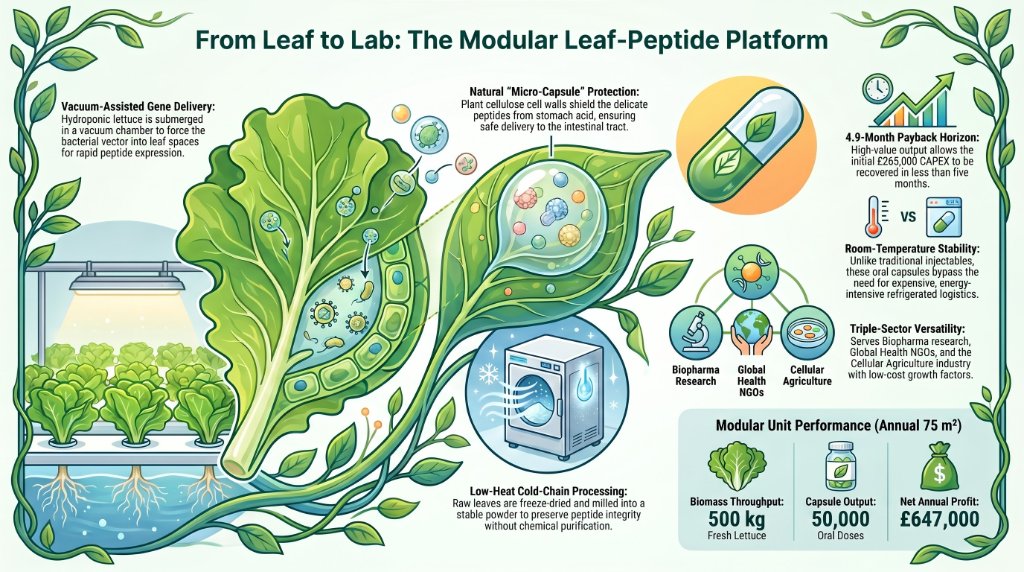
The Modular Leaf-Peptide Platform — from vacuum-assisted gene delivery to oral capsule production
Executive Summary (1/9)
Product Categories & Chemical Metrics
To function effectively inside a raw, unpurified oral leaf delivery system, the vertical farm focuses on structured peptides that withstand gastrointestinal breakdown. Standard linear peptides degrade rapidly, but the following classes are structurally suited for direct oral consumption.
Oral Autoimmune & Gastrointestinal Inflammatory Therapeutics
Biological Mechanism
Features a head-to-tail cyclic backbone cross-linked by three internal disulfide bonds (a knottin fold configuration). Highly stable against protease enzymes in the human stomach. Expressed in lettuce leaves, the peptide passes safely into the intestinal tract where it blocks inflammatory proteases locally, providing targeted management for Crohn's disease and Ulcerative Colitis.
Alternative Target
Elafin (Protease Inhibitor) — A 57-amino-acid human-derived protein segment used to calm epithelial degradation during acute gut inflammation flare-ups.
Oral Gut Antimicrobials
Biological Mechanism
A stable cyclic peptide capable of surviving stomach acid. Once released by gut microbes breaking down the lettuce cell wall in the colon, Kalata B1 exerts targeted antimicrobial and cytotoxic activity against localised, drug-resistant bacterial pathogens without leaking into the systemic bloodstream, protecting the native systemic microbiome.
Oral Metabolic Signaling Scaffolds
Biological Mechanism
A small 14-amino-acid bicyclic loop known for its physical stability. The platform uses SFTI-1 as a molecular scaffold, replacing a segment of its unreactive loop with specific amino acid sequences engineered to match human ghrelin or leptin receptors. The core structure remains intact through the stomach, allowing the engineered loop to interact directly with metabolic tracking centers in the gut lining to assist in obesity and insulin-response therapies.
Oral Vaccine Antigens (Chimeric Immunogens)
Biological Mechanism
The target peptide is fused directly to a Cholera Toxin B (CTB) subunit carrier. CTB binds with high affinity to GM1 ganglioside receptors on the surface of intestinal epithelial cells. When a patient consumes the raw leaf powder, the CTB complex is delivered to the gut lining, guiding the attached proinsulin or viral antigen directly into the intestinal immune system (Peyer's Patches). This mucosal priming trains the body to build defensive antibodies or establish immune tolerance, currently studied for Type 1 Diabetes mitigation.
Strategic Buyer Groups
The market for this unpurified therapeutic lettuce bypasses traditional retail consumers and centres completely on three business-to-business (B2B) institutional buyers.
Buyer Group 1
CDMOs & Biopharma Researchers
Who They Are
Clinical-stage biotechnology firms, academic research consortiums, and contract drug manufacturing groups developing target pipelines for gastrointestinal diseases.
The Problem They Face
Traditional mammalian cell culture or chemical peptide synthesis takes months to modify and requires massive upfront capital for pure isolation chemistry, frequently blocking early-stage preclinical and Phase I trial designs.
Value Proposition
The micro-pilot facility offers rapid validation turnaround. When a biopharma partner needs to test an anti-inflammatory cyclic peptide variant, the vertical farm inserts their specific sequence into the Agrobacterium vector. Within 6–8 weeks, the facility delivers standardised, bioencapsulated oral trial capsules — cutting preclinical timelines and removing the need for industrial chromatography validation.
Buyer Group 2
International Public Health & Global NGOs
Who They Are
Institutional buyers like the World Health Organization (WHO), UNICEF, GAVI (The Vaccine Alliance), and governmental health ministries operating in developing nations.
The Problem They Face
Traditional injectable vaccines and therapeutic peptides depend on strict 'cold chain' logistics. If a medicine is not constantly refrigerated from the factory floor to the field clinic, it denatures and spoils. Injectables also require sterile needles, disposal systems, and trained medical personnel.
Value Proposition
Freeze-dried, bioencapsulated vaccine antigens and oral therapies inside lettuce leaf powder remain completely stable at room temperature for long periods. These global health agencies can procure capsules in bulk, ship them via standard logistics without cold storage, and distribute them without needles — simplifying delivery in remote or resource-limited environments.
Buyer Group 3
Cellular Agriculture & Cultivated Meat Startups
Who They Are
Scale-up stage cultured meat and seafood companies developing alternatives to animal farming.
The Problem They Face
Cultivated meat requires feeding stem cells a nutrient media dense with Growth Factors (such as human Epidermal Growth Factor, hEGF). Because these peptides are traditionally produced using expensive mammalian bioreactors, growth factors cost tens of thousands of pounds per gram — creating a major economic bottleneck for the clean meat industry.
Value Proposition
By switching the genetic expression cassette to code for growth factors, the micro-pilot vertical farm transitions into an industrial supplier for cellular agriculture. Startups buy the fresh or frozen lettuce biomass by the kilogram, blend it into a crude plant extract, and add it directly to their large-scale cell growth vats — providing a low-cost, animal-free source of growth factors.