Peptide Library
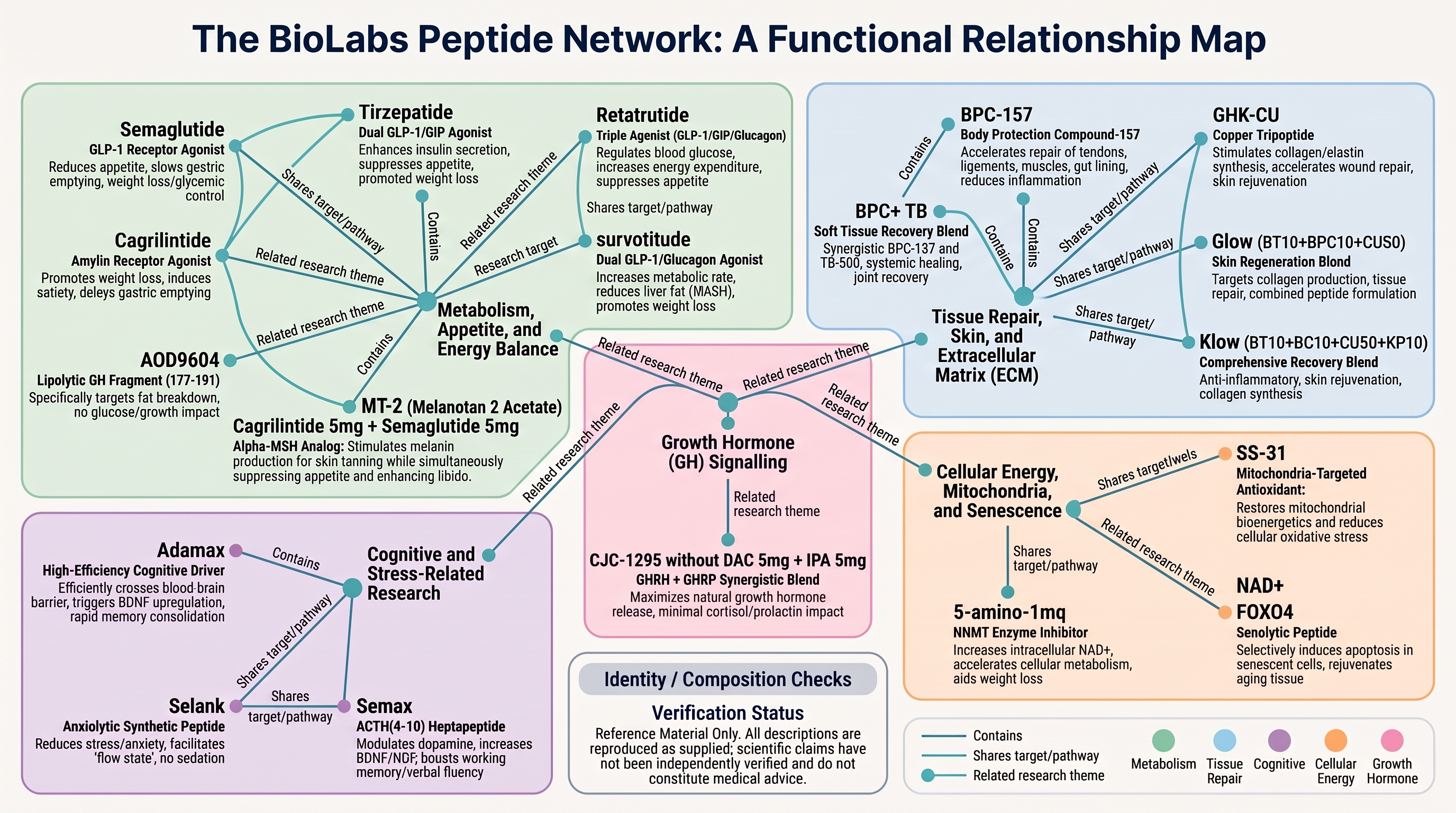
A curated reference database of 35 peptide profiles — evidence levels, benefits, administration routes, and safety information.
Educational resource only. This library is provided for informational purposes. Not medical advice. Consult a licensed clinician before using any peptide. BioLabs does not supply, endorse, or recommend any of the substances listed.
Showing 35 of 35 peptides
Semaglutide
GLP-1 Receptor Agonist
A GLP-1 receptor agonist approved by regulatory agencies for type 2 diabetes and chronic weight management. Works by mimicking incretin hormones that regulate blood sugar and appetite.
Tirzepatide
GIP/GLP-1 Dual Agonist
A dual GIP and GLP-1 receptor agonist approved for type 2 diabetes and chronic weight management. Acts on two incretin hormone pathways to regulate blood sugar and reduce appetite.
Tesamorelin
Egrifta (GHRH Analog)
An FDA-approved synthetic GHRH analog for reducing excess abdominal fat in HIV patients with lipodystrophy. Stimulates the pituitary gland to produce and release growth hormone.
PT-141
Bremelanotide
A melanocortin receptor agonist FDA-approved for treating hypoactive sexual desire disorder (HSDD) in premenopausal women. Acts through the central nervous system.
GHRP-6
Growth Hormone Releasing Peptide-6
A synthetic hexapeptide that stimulates growth hormone release from the pituitary gland. A first-generation growth hormone secretagogue known for its hunger-stimulating effects.
CJC-1295-DAC
Long-Acting GHRH Analog
A modified GHRH analog with an added Drug Affinity Complex (DAC) that extends its half-life, allowing for less frequent dosing compared to standard CJC-1295.
Ipamorelin
NNC 26-0161
A selective growth hormone secretagogue and ghrelin mimetic that stimulates growth hormone release without significantly affecting cortisol or prolactin levels.
AOD-9604
Advanced Obesity Drug
A modified fragment of human growth hormone (amino acids 176-191) developed to retain fat-reducing effects of HGH without growth-promoting effects.
Thymosin Alpha-1
Tα1
A thymic peptide approved in several countries for treating certain immune-related conditions. Research has explored its role in immune system modulation and cellular function.
GHK-Cu
Copper Peptide
A copper-binding peptide naturally found in human plasma, saliva, and urine. Extensively studied for skin health and wound healing, with some topical formulations commercially available.
GHRP-2
Growth Hormone Releasing Peptide-2
A synthetic hexapeptide that stimulates growth hormone release from the pituitary gland. A second-generation growth hormone secretagogue with less hunger stimulation than GHRP-6.
Hexarelin
Examorelin
A synthetic hexapeptide and potent growth hormone secretagogue. Research has also explored its potential cardioprotective effects beyond growth hormone stimulation.
NAD+
Nicotinamide Adenine Dinucleotide
A coenzyme central to cellular energy metabolism. Research has explored its potential role in cellular health, energy production, and age-related metabolic decline.
Oxytocin
Neuropeptide Hormone
A naturally occurring neuropeptide and hormone involved in social bonding, trust, and emotional regulation. Research has explored its potential in anxiety, autism spectrum disorder, and social function.
Cerebrolysin
Neuropeptide Complex
A neuropeptide complex derived from porcine brain protein. Approved in some countries for neurological conditions. Research has explored its potential neuroprotective and neurorestorative properties.
BPC-157
Body Protection Compound-157
An experimental synthetic peptide derived from a protective stomach protein, frequently discussed in relation to soft-tissue recovery and gastrointestinal support. Human clinical data remains limited.
TB-500
Thymosin Beta-4
A synthetic version of the naturally occurring peptide Thymosin Beta-4, often discussed for its potential role in tissue repair and recovery. Robust human clinical evidence is sparse.
CJC-1295 / Ipamorelin
GHRH + GHS Combination
CJC-1295 and Ipamorelin are peptides that stimulate the release of growth hormone. Often combined and discussed for potential effects on body composition, recovery, and sleep quality.
Melanotan-2
MT-2
A synthetic peptide analog of alpha-melanocyte stimulating hormone, discussed for its effects on skin pigmentation and libido. Not approved by major regulatory agencies; safety data is limited.
MOTS-C
Mitochondrial-Derived Peptide
A mitochondrial-derived peptide that plays a role in metabolic regulation and cellular energy. A relatively new area of research exploring mitochondrial function and metabolic health.
IGF-1 LR3
Long R3 IGF-I
A modified version of insulin-like growth factor-1 with amino acid substitutions that extend its half-life and reduce binding to IGF binding proteins.
KPV
Lys-Pro-Val Tripeptide
A tripeptide derived from alpha-melanocyte stimulating hormone (α-MSH). Research has explored its anti-inflammatory properties, particularly in the gastrointestinal tract.
LL-37
Cathelicidin
A human antimicrobial peptide naturally produced by the body as part of the innate immune response. Research has explored antimicrobial properties and potential role in wound healing.
Follistatin-344
FS-344
A naturally occurring protein that binds to and inhibits myostatin, a protein that limits muscle growth. Research has explored its potential role in muscle development and metabolic regulation.
5-Amino-1MQ
NNMT Inhibitor
A small molecule that inhibits the enzyme NNMT (nicotinamide N-methyltransferase). Research has explored its potential effects on metabolism and energy expenditure in preclinical models.
HGH Fragment 176-191
Frag 176-191
A modified fragment of human growth hormone researched for its potential fat-reducing effects without the growth-promoting properties of full HGH. Closely related to AOD-9604.
DSIP
Delta Sleep-Inducing Peptide
A neuropeptide first isolated in the 1970s. Research has explored its potential role in sleep regulation and stress response modulation, though human clinical evidence remains limited.
SS-31
Elamipretide
A mitochondria-targeted peptide that stabilises the inner mitochondrial membrane. Research has explored its potential in conditions related to mitochondrial dysfunction and oxidative stress.
VIP
Vasoactive Intestinal Peptide
A neuropeptide that acts as a neuromodulator and neurotransmitter. Research has explored its role in immune regulation, gastrointestinal function, and inflammatory conditions.
Humanin
Mitochondrial Peptide
A mitochondrial-derived peptide with cytoprotective properties. Research has explored its potential roles in cellular survival, metabolic regulation, and neuroprotection.
Epitalon
Epithalon
A synthetic tetrapeptide studied for its potential effects on the pineal gland and circadian rhythms. Research has explored its relationship with melatonin production and cellular aging markers.
Selank
TP-7 (Russia-approved anxiolytic)
A synthetic peptide developed in Russia based on the naturally occurring peptide tuftsin. Approved in Russia as an anxiolytic and nootropic, though experimental in most other countries.
Semax
ACTH(4-10) Fragment
A synthetic peptide developed in Russia based on a fragment of ACTH. Approved in Russia as a nootropic and neuroprotective agent, though experimental in most other countries.
Dihexa
PNB-0408
A small peptide derived from angiotensin IV. Preclinical research has explored its potential role in cognitive enhancement and synaptic plasticity, though human data is very limited.
Pinealon
EDR Tripeptide
A synthetic tripeptide (Glu-Asp-Arg) studied in Russia for potential effects on the central nervous system and cellular aging. Evidence is primarily from preclinical and limited Russian clinical studies.