BioLabs Files Six-Application Patent Family for Bioencapsulated Peptide Systems
12 October 2026Biolabs Legal DepartmentResearch & DevelopmentIntellectual Property
BioLabs has filed six coordinated U.S. provisional patent applications covering bioencapsulation, controlled biological production, sensing, automated quality control and autonomous therapeutic-production systems.
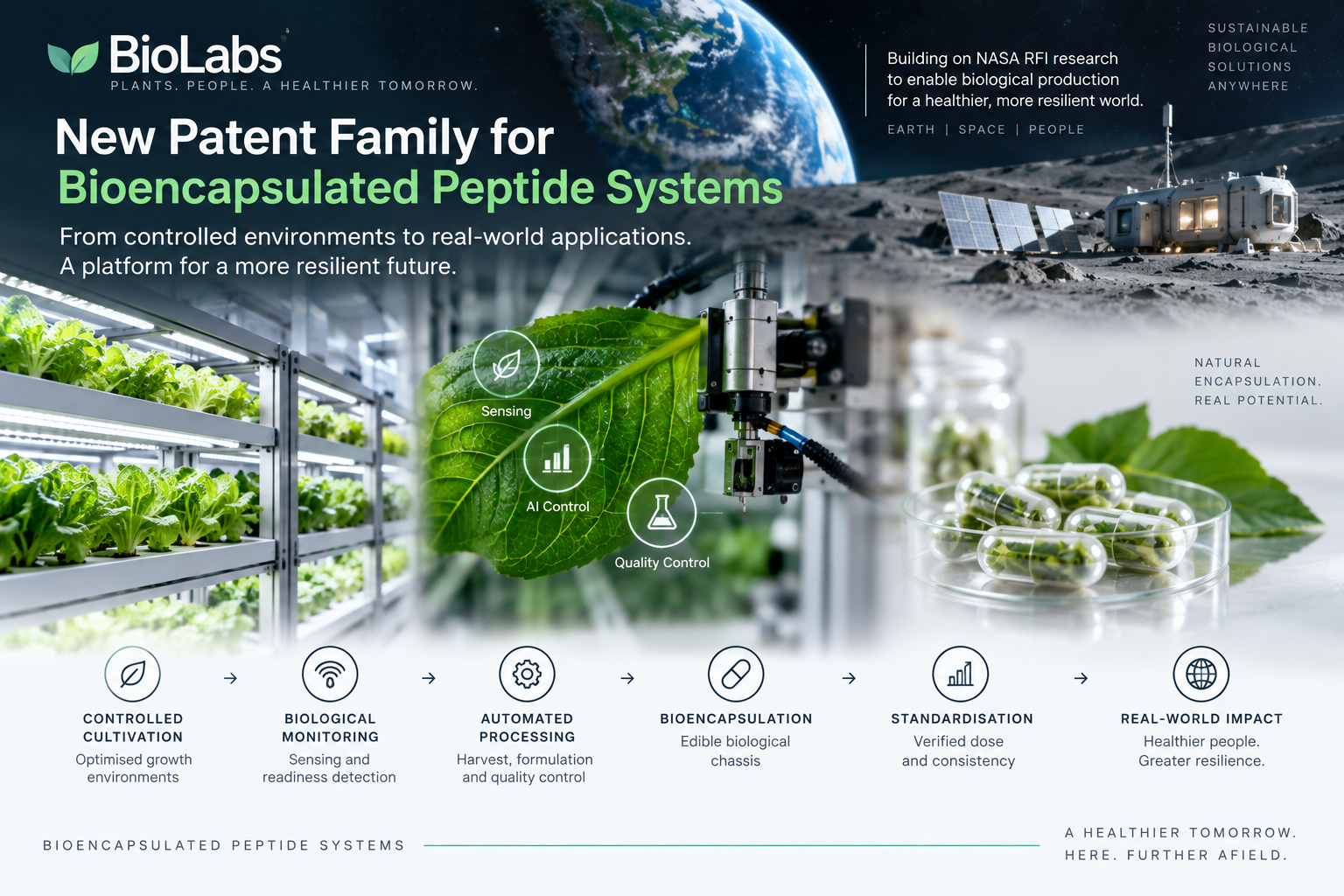
Bioencapsulated Peptide Systems: building on NASA RFI research to enable biological production for a healthier, more resilient world.
BioLabs has filed a coordinated family of six U.S. provisional patent applications covering complementary elements of its emerging Bioencapsulated Peptide Systems (BPS) platform.
The applications were filed with the United States Patent and Trademark Office on 12 October 2026 and extend BioLabs’ existing intellectual-property portfolio beyond controlled-environment agriculture into biological production, bioencapsulation, automated quality control and closed-loop therapeutic manufacturing.
The new family comprises one umbrella systems application and five related applications addressing specific parts of the platform.
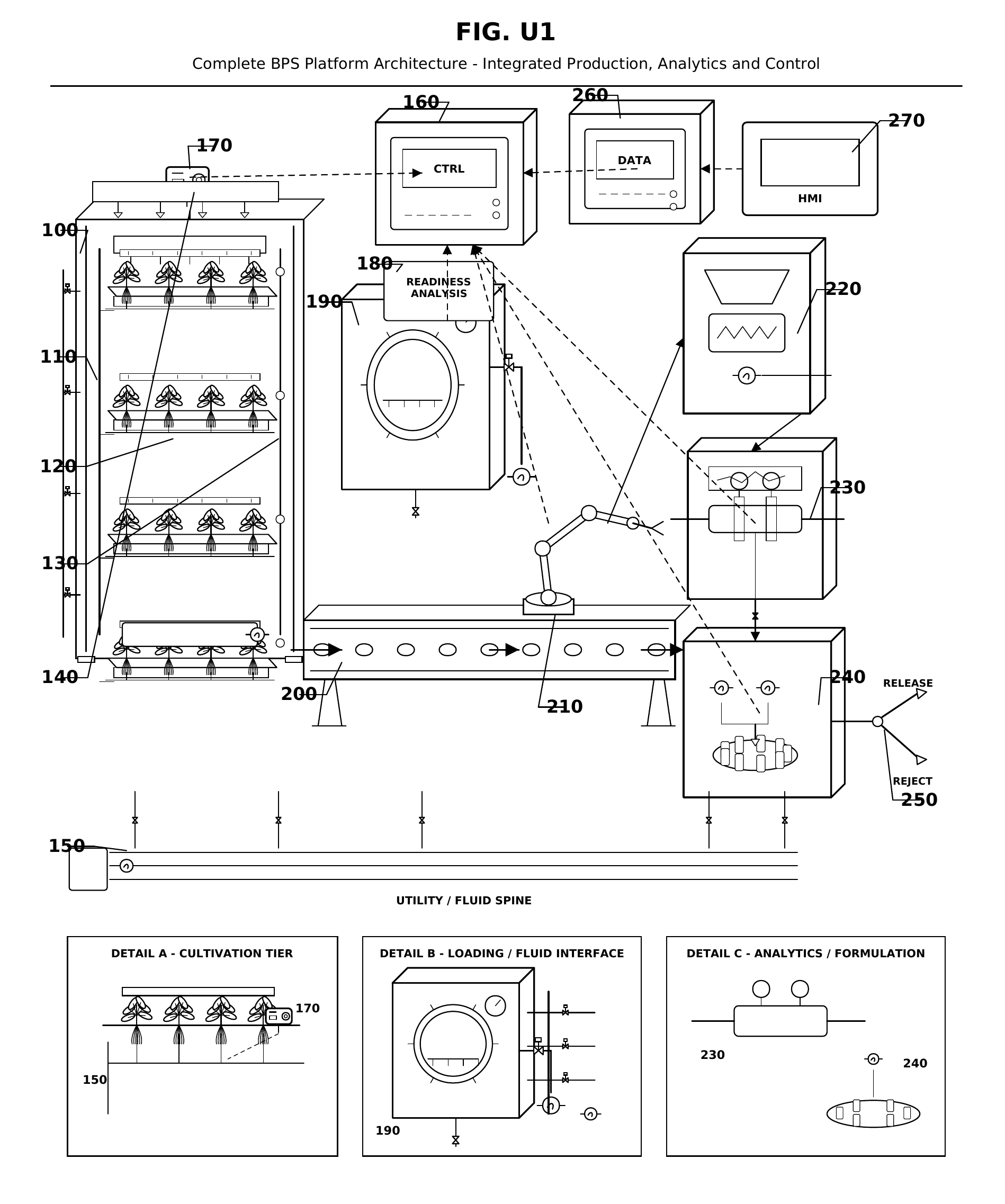
FIG. U1 — Integrated Bioencapsulated Peptide Systems architecture showing cultivation, monitoring, processing, analytical verification, formulation and supervisory control.
Six coordinated applications
The applications are:
- U.S. Provisional Application No. 64/174,222
Bioencapsulated Peptide Systems Platform and Methods Therefor - U.S. Provisional Application No. 64/174,226
Edible Biological Chassis and Oral Bioencapsulation Platform - U.S. Provisional Application No. 64/174,230
Controlled-Environment Production, Standardisation and Dose Normalisation of Bioencapsulated Therapeutic Biomass - U.S. Provisional Application No. 64/174,231
Sensor-Guided Biological Readiness Detection and Closed-Loop Actuation for Bioencapsulated Therapeutic Production - U.S. Provisional Application No. 64/174,232
Automated Harvest, Formulation and Inline Quality Release of Bioencapsulated Peptide Doses - U.S. Provisional Application No. 64/174,233
Autonomous Closed-Loop Bioencapsulated Therapeutic Production Platform
All six applications name Dr Paul Hilton as inventor.
From controlled environments to integrated biological systems
BioLabs’ earlier patent filings have focused heavily on controlled-environment production: root-zone engineering, closed-loop cultivation, modular production systems, assay-linked environmental control and high-density crop architectures.
The BPS patent family represents a logical extension of that work.
Rather than treating the biological material simply as a crop to be grown and harvested, the new applications consider the biological chassis as part of a wider production and delivery system.
That introduces a different set of technical questions:
- how biological material can protect peptide or protein payloads;
- how controlled-environment parameters can be used to improve production consistency;
- how biological readiness can be detected before a treatment or production step is initiated;
- how harvested material can be analysed and normalised against a defined dose specification;
- and how these processes can ultimately be integrated into an autonomous closed-loop production architecture.
The result is a patent family structured around the progression from biological production environment to verified therapeutic output.
Systems thinking developed through the NASA LEIA RFI
The filing follows a period of systems-development work undertaken by BioLabs and CAVU Aerospace UK in connection with a recent response to NASA’s NextSTEP-3 Lunar Enabling Infrastructure Accelerator (LEIA) Request for Information.
The consortium’s submission addressed Topic 4: In-Space Advanced Manufacturing / Lunar Base Infrastructure and considered how biological production might operate in environments where conventional pharmaceutical supply chains, continuous human intervention and Earth-based processing cannot be assumed.
The proposed architecture combined BioLabs’ controlled-environment and biological systems work with CAVU’s avionics and edge-computing capabilities. It examined a closed-loop process incorporating cultivation, biological monitoring, controlled actuation, autonomous processing and point-of-need production.
One of the most important concepts explored during that work was the use of an edible biological chassis as a natural bioencapsulation matrix.
In the LEIA proposal, Lactuca sativa was considered as a dual-use biological chassis capable of supporting both food production and the potential delivery of bioencapsulated therapeutic payloads. The proposal examined whether plant cellular structures could reduce dependence on some of the downstream purification and formulation steps normally associated with biological manufacture.
The NASA RFI work did not represent validation or approval of BioLabs’ underlying biological platform. It was a development proposal. Its significance for BioLabs was different: it required the team to consider the biological, mechanical, analytical and computational elements as one integrated system.
That work helped sharpen a number of terrestrial research questions that now sit at the centre of the BPS programme.
A broader platform, not a single therapeutic
The BPS patent family is deliberately platform-oriented.
The applications are not centred on a single peptide, disease area or therapeutic product. Instead, they seek to protect systems and methods that may be applicable across multiple classes of peptide and protein research.
The programme includes work around:
- biological matrices and oral bioencapsulation;
- controlled-environment production;
- batch and dose standardisation;
- sensor-guided biological-state assessment;
- automated harvest and formulation;
- inline analytical quality control;
- supervisory computation;
- and autonomous biological production.
This distinction is important to BioLabs’ research strategy.
The company continues to regard Plant Molecular Farming (PMF) as a separate and more research-intensive field requiring substantial further work in molecular biology, synthetic biology, expression systems and recombinant protein production.
BPS is intended to build from capabilities BioLabs already possesses in controlled-environment systems while creating a platform that can increasingly interface with those more advanced biological-production technologies.
Research collaboration will be central to the next stage
The filing of the BPS family is therefore a starting point rather than an endpoint.
BioLabs intends to develop the platform through a combination of internal research and external academic collaboration, particularly in areas including:
- peptide and protein stability;
- gastrointestinal protection and release;
- biological chassis selection;
- analytical dose standardisation;
- biosensing;
- synthetic biology;
- automated bioprocessing;
- and AI-assisted biological control.
The same architecture also has relevance beyond conventional laboratory environments.
The LEIA work demonstrated how many of these questions become even more important in remote and resource-constrained settings, where local production, autonomous monitoring and minimal downstream processing can have significant operational value.
Building a connected IP platform
The six BPS filings sit alongside BioLabs’ earlier controlled-environment patent applications and bring the company’s current U.S. provisional patent portfolio to eleven filed applications.
The portfolio now spans two increasingly connected areas:
Controlled-environment biological production
and
Bioencapsulated Peptide Systems
Together, they reflect BioLabs’ broader objective: to develop physical and computational systems capable of making biological production more controlled, measurable, reproducible and ultimately more autonomous.